
What if the most important question before signing a DeFi transaction is not “Which wallet has the most features?” but “Can I see what this transaction is expected to do?” That distinction changes how users should think about Rabby, especially when moving between Ethereum, Layer 2 networks, sidechains, and other EVM-compatible environments. For German-speaking DeFi users, the practical appeal of a Rabby Chrome extension is not simply convenience. It is the attempt to place more information between a dApp’s request and the user’s signature.
Rabby is a non-custodial wallet developed by DeBank and designed around multi-chain DeFi. Its central promise is a smoother workflow across more than 140 EVM-compatible networks, including Ethereum, Polygon, Arbitrum, Optimism, Avalanche, Base, and BNB Chain. But a wallet cannot make an on-chain action safe merely by displaying a polished interface. The more useful way to evaluate Rabby is to examine its mechanisms: transaction simulation, security warnings, network handling, key custody, and the limits that remain outside the wallet’s control.
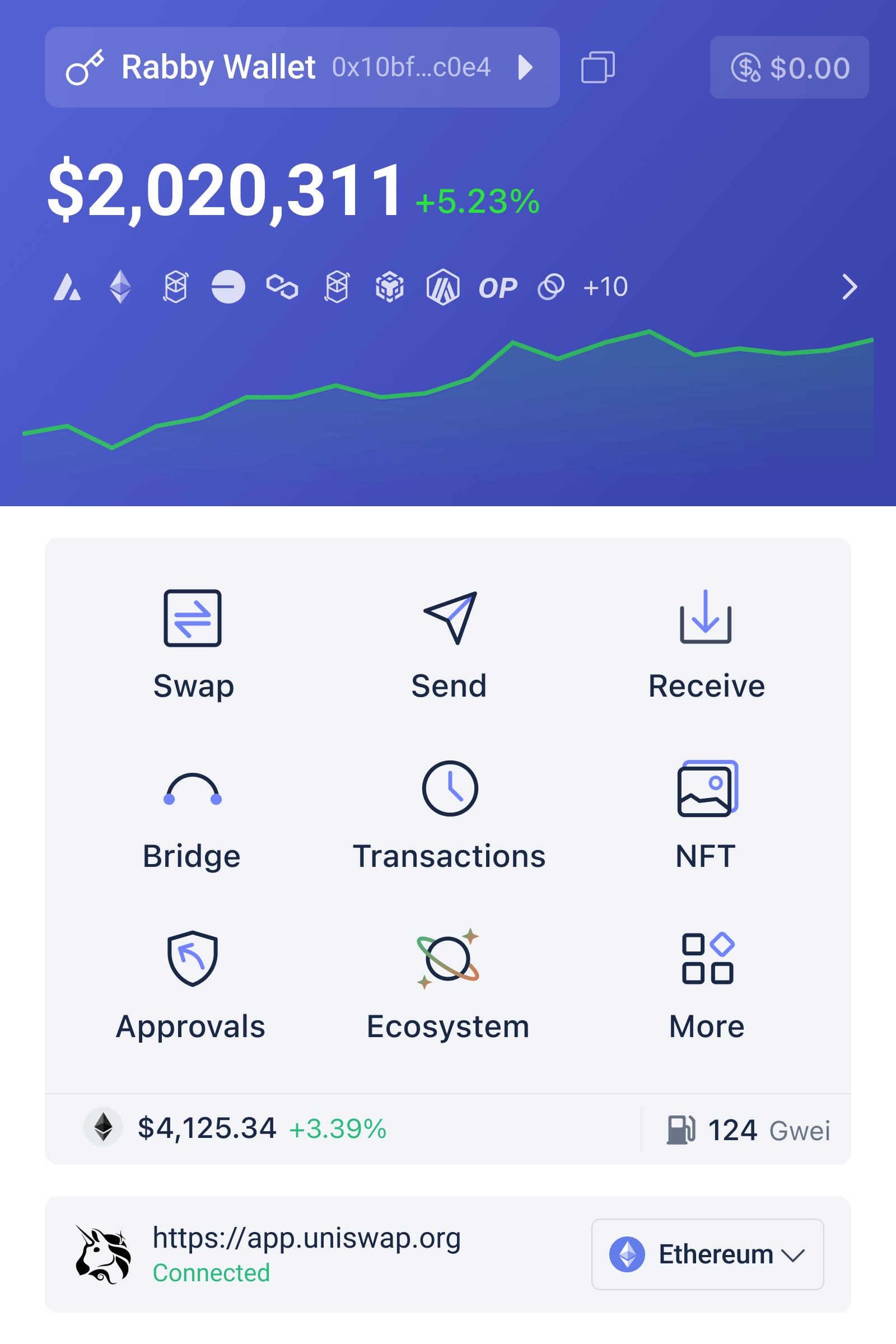
How to install the Rabby Chrome extension safely
For users searching for “rabby installieren,” the first principle is source verification. A browser wallet is security-sensitive software, so installation should begin from an official distribution channel rather than from an advertisement, an unsolicited message, or a copied search result. Rabby is primarily available as a browser extension for Chrome, Brave, and Edge, with desktop applications for Windows and macOS and mobile applications for iOS and Android. The Chrome Web Store description available in late August 2026 presents Rabby as an open-source Ethereum and EVM wallet focused on DeFi and multi-chain use.
After installation, the setup decision is more important than the visual onboarding. A new wallet can generate a seed phrase, while an existing wallet can be imported. Users should never enter a seed phrase into a website, support form, cloud document, or chat window. If a hardware wallet is available, connecting a Ledger, Trezor, or OneKey device can reduce the exposure of private keys during signing. Rabby remains non-custodial: private keys are stored locally on the user’s device and are not sent to Rabby’s servers.
That benefit also creates responsibility. Non-custodial does not mean risk-free. If a seed phrase is exposed, the wallet interface cannot reverse the loss. Malware, a compromised browser profile, a malicious extension, or a deceptive dApp can still affect the signing environment. A secure installation therefore involves more than clicking “Add to Chrome”: verify the source, protect the recovery material, keep the browser environment controlled, and test with a small amount before committing meaningful funds.
Transaction simulation: a better mental model for signing
Rabby’s transaction simulation is its most educational feature. Before the user signs, the wallet attempts to simulate the transaction and present the expected changes to token balances and other relevant state. In plain language, it asks: if this call succeeds as represented, what should leave the wallet, what should arrive, and which permissions may change?
This matters because a blockchain transaction request is often opaque to non-specialists. A dApp may display “Deposit,” “Mint,” or “Claim,” while the underlying contract call contains several parameters and may request a token approval. Simulation translates part of that technical request into a consequence-oriented view. Instead of treating the signature as a routine confirmation, the user can compare the proposed action with the intended action.
The non-obvious point is that simulation is not the same as prediction in the ordinary sense. It is a conditional execution result. The simulation depends on the current blockchain state, the selected network, the contract logic, available data providers, and the transaction being represented correctly. State can change between simulation and mining. A contract can also contain behavior that is difficult to model, depend on external data, or react differently under changed conditions. Simulation reduces uncertainty; it does not eliminate it.
This is why the safest reading habit is comparative. Check the network, the destination contract, the assets leaving your wallet, the assets expected in return, and the requested approvals. If the simulation shows an unexpected token transfer, an unlimited allowance, or no meaningful result for an action that should produce one, pause. Do not sign merely because the dApp is familiar or because the transaction appears urgent.
Security warnings are useful, but they are not a verdict
Rabby includes a security engine that checks contracts and addresses for signals associated with phishing, known exploits, and potentially dangerous approvals. It can also highlight risks such as infinite token allowances. This is valuable because users often make decisions under interface pressure: a transaction appears to be the final step in a yield strategy, a bridge transfer, or a token claim, and the natural impulse is to approve it quickly.
Yet a warning system should be understood as a risk filter, not as an oracle. A clean result does not prove that a contract is economically sound, audited, solvent, or aligned with the user’s interests. Conversely, a warning may reflect limited information rather than a definitive exploit. The correct workflow is layered: use the wallet’s warning and simulation, inspect the dApp and contract context independently, minimize approvals where possible, and separate experimental funds from long-term holdings.
This distinction also clarifies Rabby’s position relative to MetaMask. MetaMask is widely supported and deeply integrated across the Ethereum ecosystem, making it a practical default for many users. Rabby emphasizes multi-chain navigation, transaction previews, and security-oriented interpretation. A specialist wallet may provide more context, but that context can also create a false sense of completeness. The trade-off is not “safe wallet versus unsafe wallet”; it is between different interfaces for managing the same underlying smart-contract risks.
Multi-chain convenience and the hidden cost of abstraction
Rabby can automatically detect the network required by a connected dApp and switch to it, reducing the friction of manual network selection. Its broad EVM coverage is particularly relevant for users in Germany who move between Ethereum mainnet, rollups, and lower-cost networks for lending, swaps, liquidity provision, or NFT activity. The integrated swap function can scan decentralized exchange venues such as Uniswap and 1inch, while bridge integrations such as LI.FI allow cross-chain transfers from within the interface.
The Gas Account feature addresses another familiar problem: holding the native token of every network used for fees. Where supported, users can pay gas across networks with stablecoins such as USDC, even when they lack the native token required by the chain. This is convenient, but it does not remove the economic cost of execution. A stablecoin fee may hide the conversion or routing mechanics, and bridge transactions still involve protocol, liquidity, counterparty, and settlement risks.
Abstraction improves usability by hiding infrastructure. That is its strength and its danger. When the wallet automatically changes networks, selects a route, or makes gas payment appear uniform, users may forget that they are interacting with distinct systems governed by different contracts and liquidity conditions. A good multi-chain wallet should reduce operational mistakes, but a careful user still needs to know which chain holds the asset and which protocol is responsible for moving it.
Where Rabby fits among alternative approaches
Rabby is most compelling for users whose activity is already multi-chain and DeFi-heavy. Compared with a general-purpose browser wallet, it offers stronger transaction interpretation and a workflow built around switching networks and reviewing effects. Compared with a hardware wallet used through a minimal interface, it provides more context before signing, but the hardware device remains the stronger protection for keeping signing keys isolated. Compared with custodial exchange wallets, Rabby gives users direct control and access to permissionless applications, while also returning the responsibility for backups, approvals, and operational security.
There is no universal winner. A beginner holding a small amount may prioritize simplicity. An active DeFi user may value simulation and route visibility. A larger account may reasonably combine Rabby with a hardware wallet, using the browser extension as the analysis layer and the hardware device as the signing boundary. This layered model is often more robust than asking one wallet to solve every security problem.
Rabby’s open-source architecture, released under the MIT license, allows community inspection of the software. Its backend independence is also relevant: Rabby does not create or alter transactions on the user’s behalf, and core signing functions can remain available even if Rabby services are unavailable. These properties improve resilience and transparency, but they do not guarantee that every dependency, browser, RPC endpoint, or connected dApp is trustworthy.
A practical decision framework for signing
Before confirming a transaction, ask four questions. First, am I on the intended network? Second, does the simulated balance change match the action I wanted? Third, am I granting a permission that lasts longer or reaches further than necessary? Fourth, would losing the funds involved materially damage my finances? If the final answer is yes, use a hardware wallet, test with a smaller amount, and investigate the contract rather than relying on interface confidence.
These questions turn transaction simulation into a reusable security habit. The most important output is not a green check mark. It is a mental comparison between intent and execution. If the two diverge, the transaction deserves scrutiny regardless of how popular the dApp is.
Rabby Points, earned through activities such as swaps, gas top-ups, or referrals, add a loyalty layer to the product. Such incentives may encourage engagement, but they should not influence a security decision. A points system can make activity feel rewarding precisely when restraint would be wiser. In DeFi, the cheapest transaction is often the one not signed.
What to watch next
The direction of wallet design is clear: more actions are being compressed into a single interface. Swaps, bridges, gas abstraction, automatic network switching, and security analysis are converging. If this trend continues, the competitive question will be less about whether wallets support another chain and more about whether they can explain cross-chain consequences accurately enough for users to make informed decisions.
The key uncertainty is how reliable and transparent those explanations will remain as contracts become more composable and transaction bundles more complex. Users should therefore treat simulation quality, warning clarity, hardware-wallet support, and the ability to inspect raw transaction details as ongoing evaluation criteria. Convenience is valuable, but verifiable context is more valuable.
FAQ: Rabby installation and transaction simulation
Is Rabby a custodial wallet?
No. Rabby is designed as a non-custodial wallet. Private keys are stored locally on the user’s device, so the user remains responsible for seed phrase protection, device security, and transaction approval.
Does transaction simulation guarantee that a transaction is safe?
No. Simulation shows expected effects under a particular state and execution context. It can reveal unexpected transfers or approvals, but it cannot guarantee that a contract is honest, that market conditions will remain unchanged, or that every complex behavior has been represented perfectly.
Can Rabby replace a hardware wallet?
For small, routine activity, some users may rely on the browser extension alone. For significant holdings, a hardware wallet adds a stronger signing boundary. Rabby can work with Ledger, Trezor, and OneKey, combining detailed transaction review with more isolated key storage.
Where can I learn more before installing?
Readers comparing installation and setup information can review this rabby wallet resource, then verify that the software is obtained through an official distribution channel.